Baccarat Rules for Beginners: How to Play, Odds and Strategy

Baccarat looks intimidating from the outside — velvet tables, big stakes, a dealer who never seems to explain anything. In reality, learning how to play baccarat takes about five minutes. You make one decision per round, the cards follow fixed rules, and the only real skill is choosing the right bet and managing your money.
This guide covers everything in order: what the game is, how a round works, card values, the third-card rules (with a chart you can keep open while you play), payouts, odds and which strategies are worth your time.
Quick answer: To play baccarat, bet on Player, Banker or Tie. Each hand gets two cards, and the hand closer to 9 wins. Tens and face cards count as 0, aces as 1, and only the last digit of a total counts. A third card is drawn by fixed rules — you never decide. Banker is the best bet.
What Is Baccarat?
So what is baccarat? It is a card game where you bet on which of two hands — Player or Banker — will end up with a total closer to 9. You can also bet that both hands will tie. Despite the names, "Player" and "Banker" are just the two sides of the table: you are not the player, and you are not playing against the banker. You simply pick a side.
The game travelled from Italy to France and became a favourite of French aristocrats in the 19th century. The version played in casinos today, Punto Banco, took shape in Latin America and reached Las Vegas in the late 1950s. It is now the biggest table game in Asian casinos, and live online tables have made it popular with Indian players too.
Baccarat Meaning
The name comes from the Italian word baccara, meaning "zero" — a reference to tens and face cards, which are worth nothing in this game. In Hindi, the game is usually written as बैकारेट (baikaret), though most Indian players simply use the English name.
How to Play Baccarat: Step by Step
Here is how to play baccarat in practice. A round always follows the same six steps:
- Place your bet. Put chips on Player, Banker or Tie. Side bets such as Player Pair or Banker Pair are optional.
- Two cards for each hand. The dealer deals two cards to Player and two to Banker, face up.
- Count the totals. Add the card values and keep only the last digit. A 6 and a 9 make 15, so the total is 5.
- Check for a natural. If either hand has 8 or 9 from its first two cards, it is a "natural". Both hands stand, and the round is decided immediately.
- Draw a third card if the rules say so. Player's hand acts first, then Banker's, following the rules below. Nobody at the table makes this choice.
- Settle bets. The hand closer to 9 wins. If totals are equal, it is a Tie and Tie bets are paid; Player and Banker bets are returned.
Those are the basic baccarat rules — that is the whole game. Everything else — the charts, the roads, the systems — is detail around these six steps.
The Baccarat Table Layout
A baccarat table has three main betting areas marked PLAYER, BANKER and TIE, usually with smaller boxes for pair bets. Online, the layout is the same: you click an area to place chips. At live tables you will also see the scoreboard ("roads") showing results of previous rounds — useful for following the flow of the shoe, but, as we explain later, useless for predicting the next hand.
Baccarat Card Values
| Card | Value |
|---|---|
| Ace | 1 |
| 2–9 | Face value |
| 10, Jack, Queen, King | 0 |
The highest possible total is 9. When a total reaches 10 or more, drop the first digit:
- 7 + 8 = 15 → 5
- King + 9 = 9 → 9
- 5 + 5 = 10 → 0 (the lowest possible total, sometimes called "baccarat")
Baccarat Rules: When Is a Third Card Drawn?
This is the only part of the rules of baccarat that needs memorising — and you do not really need to, because the dealer or the software applies the rules automatically. Still, knowing them helps you follow what happens on the table.
Player's Third Card Rule
| Player's first two cards total | Action |
|---|---|
| 0–5 | Draws a third card |
| 6–7 | Stands |
| 8–9 | Natural — both hands stand |
Banker's Third Card Rule
If the Player stood with 6 or 7, Banker follows the same simple rule: draws on 0–5, stands on 6–7.
If the Player drew a third card, Banker's action depends on its own total and on the value of Player's third card:
| Banker total | Banker draws if Player's third card is… | Banker stands if Player's third card is… |
|---|---|---|
| 0–2 | Any card | — |
| 3 | 0–7 or 9 | 8 |
| 4 | 2–7 | 0, 1, 8, 9 |
| 5 | 4–7 | 0–3, 8, 9 |
| 6 | 6–7 | 0–5, 8, 9 |
| 7 | — | Always stands |
Baccarat Rules Chart
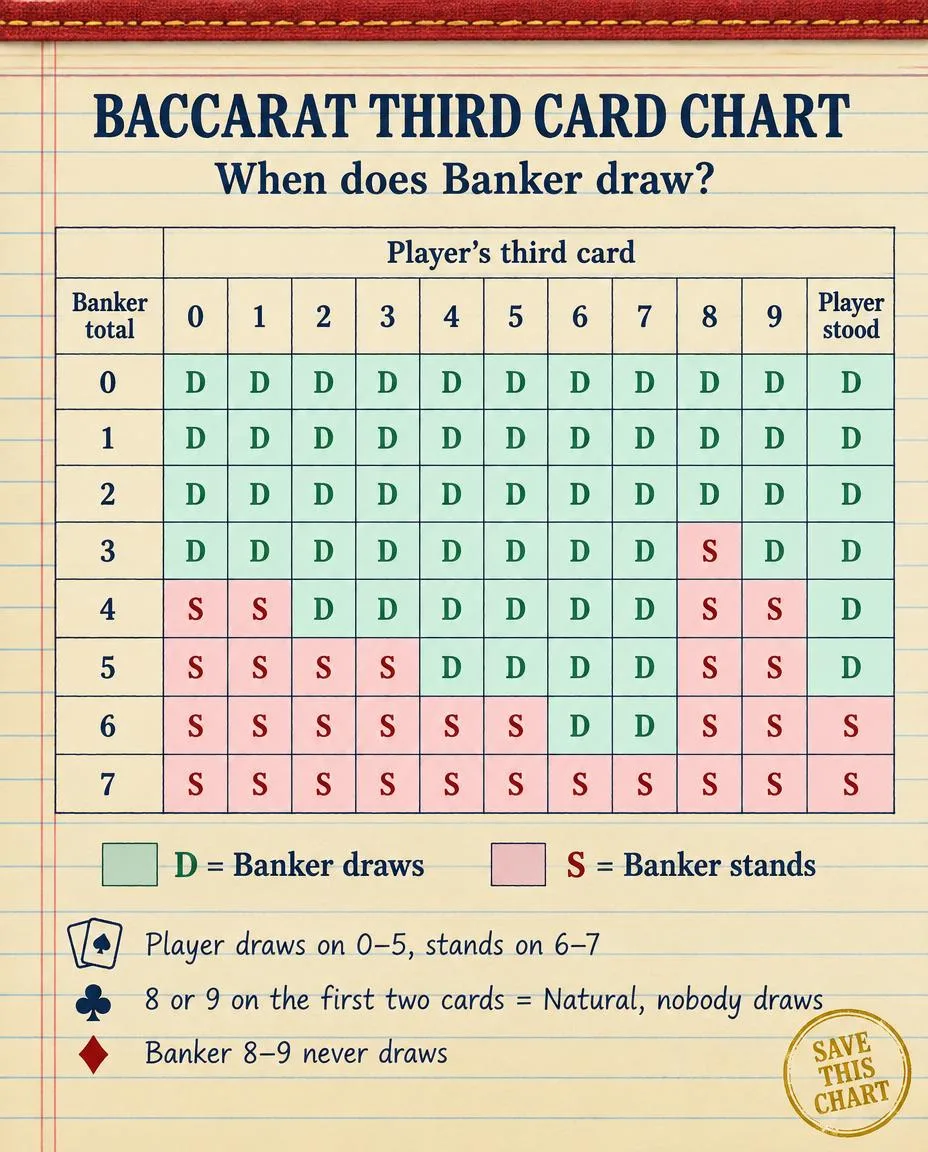
The chart puts both tables above into one grid: find Banker's total on the left and Player's third card along the top. D means Banker draws, S means it stands. Save it if you want to check the rules during a game. After a few sessions, you will recognise most situations without looking.
The pattern is easy to remember: Banker always draws on 0–2, always stands on 7, and in between it draws less often the higher its total gets.
Baccarat Examples: 3 Hands Explained
Hand 1 — a natural
Player9
Banker7
Player gets 4 and 5 (total 9). Banker gets 7 and King (total 7). Player has a natural 9, so neither hand draws. Player wins.
Hand 2 — Banker stands by the chart
Player3
Banker6
Player gets 3 and 2 (total 5) and must draw; the third card is an 8, so the total becomes 13 → 3. Banker has 6 and 10 (total 6). Checking the chart: with 6, Banker draws only if Player's third card is 6 or 7. It was 8, so Banker stands. Banker wins, 6 against 3.
Hand 3 — Banker draws by the chart
Player7
Banker9
Player gets Ace and 4 (total 5), draws a 2 and finishes on 7. Banker has 3 and Ace (total 4). With 4, Banker draws when Player's third card is 2–7 — it was a 2, so Banker draws and receives a 5. Total 9. Banker wins, 9 against 7.
Notice that in Hand 3 the Banker hand "knew" something about the Player's hand before drawing. That small informational advantage is exactly why Banker wins slightly more often — and why the casino charges a commission on it.
Baccarat Bets and Payouts
| Bet | Pays | How often it wins (8 decks) |
|---|---|---|
| Player | 1:1 | 44.62% |
| Banker | 0.95:1 (1:1 minus 5% commission) | 45.86% |
| Tie | 8:1 (some tables 9:1) | 9.52% |
| Player Pair / Banker Pair | 11:1 | about 7.5% |
Why Banker Pays a 5% Commission
Banker wins about 1.2 percentage points more often than Player because of the drawing rules. Without a commission, betting on Banker would give players an edge over the casino, so the house keeps 5% of Banker wins. A ₹1,000 Banker win pays ₹950.
Some tables — usually labelled No Commission — skip the 5% but pay only half when Banker wins with a total of 6. The house edge on Banker ends up slightly higher than at a standard table, so "no commission" is a convenience, not a discount.
Side Bets
Pair bets win when the first two cards of a hand are a pair. Many live tables add extras such as Dragon Bonus (paying on a win by a large margin or a natural). Side bets are fun in small doses, but every one of them carries a much higher house edge than Player or Banker.
Baccarat Odds and House Edge
The house edge shows how much of each bet the casino keeps on average over the long run. For a standard 8-deck game:
| Bet | Probability of winning | House edge | Relative size |
|---|---|---|---|
| Banker | 45.86% | 1.06% | |
| Player | 44.62% | 1.24% | |
| Tie (8:1) | 9.52% | 14.36% | |
| Tie (9:1) | 9.52% | 4.84% | |
| Player / Banker Pair (11:1) | about 7.5% | 10.36% |

In practical terms, for every ₹10,000 bet on Banker, you can expect to lose about ₹106 over a large number of hands. The same amount on Tie at 8:1 costs about ₹1,436. That difference is the single most important number in baccarat.
Baccarat Strategy: How to Play Baccarat and Win (Realistically)
Let us be direct: no strategy can remove the house edge. What a good strategy can do is keep that edge as small as possible, make your money last longer and help you walk away at the right moment. That is how you "win" at baccarat in any meaningful sense.
Bet on Banker
It has the lowest house edge on the table, even after commission. If you want the mathematically strongest approach, betting Banker every hand is it. Switching to Player now and then costs only a little extra (1.24% instead of 1.06%), so it is fine if you enjoy variety.
Skip the Tie and Side Bets
An 8:1 payout looks tempting, but a 14.36% house edge makes Tie roughly 13 times more expensive than Banker. Pair bets are not much better. Treat them as an occasional treat, not part of a plan.
Bankroll Management
Decide your session budget before you sit down, and split it into 20–30 base bets. Set a loss limit (for example, the full session budget) and a win goal (for example, +50%). When you hit either one, stop. This single habit protects you better than any betting system.
Choose Your Table Carefully
Look for tables with the standard 5% commission and 8:1 or better on Tie. Lower minimum bets let your bankroll last longer, and slower tables mean fewer hands per hour — which, with a built-in house edge, means lower expected losses.
Betting Systems: Martingale, Paroli, 1-3-2-6, Fibonacci
Betting systems change the size of your bets, never the odds of the hands. A quick overview:
- Martingale — double your bet after every loss, so one win recovers everything. Start at ₹100 and lose five hands in a row, and your sixth bet is ₹3,200 to win back a net ₹100. Losing streaks of five or six happen more often than people expect, and table maximums stop the system cold.
- Paroli — the reverse: double after a win, go back to the base bet after a loss or after three wins. Losses stay small, but so do most sessions.
- 1-3-2-6 — bet 1, 3, 2 and 6 units after consecutive wins, then restart. A structured way to ride a short winning run with limited risk.
- Fibonacci — raise bets after losses following the sequence 1, 1, 2, 3, 5, 8… Slower than Martingale, but it runs into the same problem during long losing streaks.
Martingale after five losses, starting at ₹100
- Bets lost: 100 + 200 + 400 + 800 + 1,600
- ₹3,100
- Sixth bet needed
- ₹3,200
- Net result if the sixth bet wins
- + ₹100
None of these systems changes the 1.06% edge on Banker. If a system makes a session more enjoyable and you stick to your limits, use it. If it makes you bet more than you planned, drop it.
Baccarat Patterns, Predictors and "Sure Win" Formulas: Do They Work?
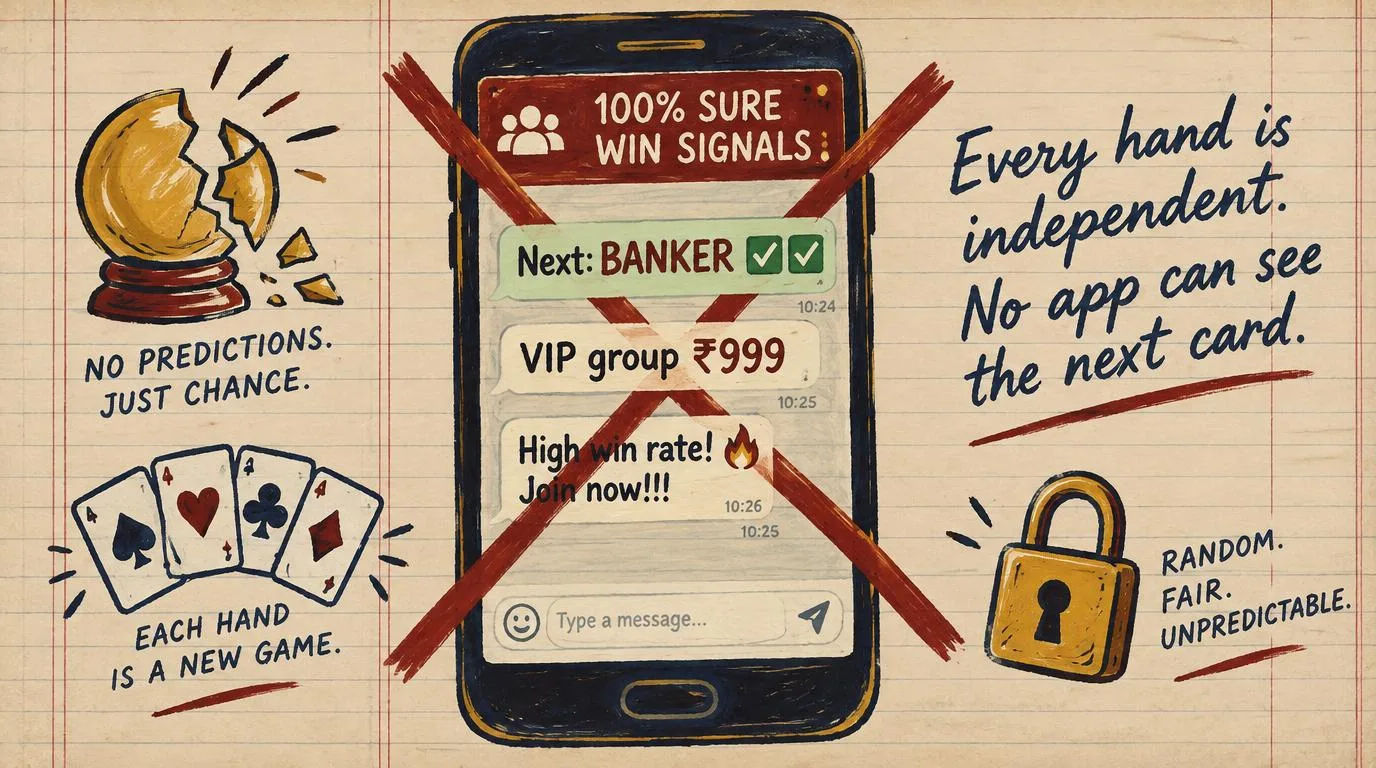
No. Every hand of baccarat is independent of the one before it. A streak of five Banker wins does not make Player "due", and it does not make a sixth Banker win more likely either.
Roads and patterns. The scoreboards at live tables — Big Road, Bead Plate, Big Eye Boy and others — are simply records of past results drawn in different ways. They are fun to follow, but they do not predict anything.
Predictors and "AI tools". Apps and Telegram channels that sell baccarat predictions, pattern software or a "sure win formula" cannot see the next card. At best they show random guesses; at worst they are built to collect your money or your account details. Avoid them.
One shoe, two scoreboards
The same 24 hands drawn two ways: 12 Banker, 10 Player, 2 ties. Neither picture tells you what comes next.
Can You Count Cards in Baccarat?
In theory, a little. Removing certain cards from the shoe slightly shifts the odds, and mathematicians have studied it. In practice, the gains are tiny, appear only in rare situations near the end of a shoe, and disappear completely at online tables that use RNG or shuffle frequently. Card counting is not a realistic way to beat baccarat.
Popular Baccarat Variants
Punto Banco — the standard casino version described in this guide. The rules are fixed, and players make no decisions beyond their bets.
Mini Baccarat — mini baccarat rules are the same as at a full table; only the table is smaller and the limits are lower. The dealer handles all the cards, so rounds are faster. Online, most RNG tables are effectively mini baccarat.
Chemin de Fer — an older European version where players take turns acting as the banker and can choose whether to draw on some totals. It is rarely offered online.
No Commission Baccarat — no 5% on Banker wins, but a Banker win with 6 pays only half.
3 Patti Baccarat — some Indian gaming apps offer baccarat-style games under this name that borrow elements from Teen Patti. The rules vary between apps, so always read the in-game help before playing.
If you want to see these games dealt by a real person, read our guide to live baccarat with real dealers, including Lightning and Speed Baccarat.
Baccarat vs Dragon Tiger
| Feature | Baccarat | Dragon Tiger |
|---|---|---|
| Cards per hand | 2–3 | 1 |
| How to win | Total closest to 9 | Higher single card |
| Third card rules | Yes | No |
| Round length | 45–60 seconds (live) | About 25 seconds |
| Lowest house edge | 1.06% (Banker) | About 3.7% (Dragon/Tiger) |
Dragon Tiger is even simpler and faster, but more expensive per bet. Read the full Dragon Tiger rules.
Ready to Play?
The best way to learn how to play baccarat is to play a few rounds in demo mode, then move to real tables with small stakes. These casinos offer low-limit baccarat and UPI deposits:
| Casino | Why | Link |
|---|---|---|
| Melbet | 250+ live baccarat tables, deposits from ₹75 | |
| 1xBet | UPI QR deposits from ₹100 | |
| Parimatch | Live tables from ₹100 and a dedicated live casino bonus |
For the full comparison, see our ranking of the best online baccarat sites in India. Play only if you are 18+ and within a budget you can afford to lose.
Baccarat FAQ
Is baccarat a 50/50 game?
Almost. Banker wins 45.86% of hands, Player 44.62%, and the remaining 9.52% are ties. Excluding ties, Banker wins about 50.7% of decided hands — which is why the casino takes a commission on Banker wins.
When do you hit in baccarat?
You never decide. "Hitting" is a blackjack term; in baccarat a third card is drawn automatically by fixed rules. Player draws on a total of 0–5 and stands on 6–7, and Banker follows the third card chart on this page. Online, the software or the live dealer applies these rules for you.
What does a 7 and 5 mean in baccarat?
A 7 and a 5 add up to 12. In baccarat only the last digit counts, so the hand is worth 2 — and it will draw a third card.
Can a total of 0 win in baccarat?
No. Zero is the lowest final total, so a hand of 0 can only tie with another 0. A two-card total of 0 always draws a third card, so it often improves before the round ends.
Does the table or seat I choose online change my odds?
No. At a live table every player bets on the same Player and Banker hands dealt from the same shoe, so your seat or screen makes no difference. What does differ between tables is the speed, the limits, the commission rule (standard or No Commission) and the side bets on offer.
Is baccarat easier than blackjack?
Yes. In blackjack you make decisions on every hand, and mistakes cost money. In baccarat you only choose your bet; the drawing is automatic.
How many decks are used in baccarat, and does it matter?
Most casino and live online tables use 8 decks; some use 6. It barely matters: the house edge stays at about 1.06% on Banker and 1.24% on Player either way, and only the Tie bet changes slightly.
Where can I play baccarat in India offline?
Land-based casinos operate legally in Goa and Sikkim, including the floating casinos on Goa's Mandovi river. Table games there often include baccarat or mini baccarat, but the game list varies, so check with the casino before you travel.
About the Baccarat Team — we are a small team of casino reviewers and table-game players. Every rule, payout and house-edge figure on this page is checked against the game providers' published rules. Read more about our team
We may earn a commission when you sign up through links on this page. Commercial partnerships can affect which casinos we list and in what order, but never the facts we report. 18+ only.